

A Legacy Rooted in the Prairie and the Iconic Sugar Hubbard Squash
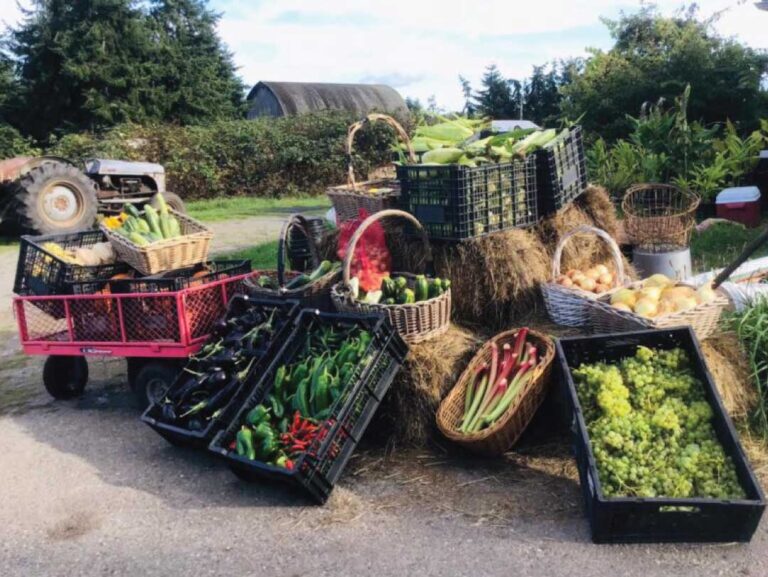
In the heart of Ebey’s Landing National Historical Reserve, where prairie grasses stretch toward the horizon and glaciers once carved the fertile soils, lies Scenic Isle Farm — a place where history, community, and agriculture are inseparable. For more than a century, the Sherman family has been farming this land, with owner Alix Roos proudly carrying forward a fifth-generation legacy that began in 1892.
“Our farm is right in the heart of Ebey’s Landing National Historical Reserve, so it’s a really special place for people to come out and get a sense of what it feels like to be on a working farm and be on the prairie in a really unique ecosystem of landscape,” Alix explains.
Today, Scenic Isle Farm operates three intertwined ventures: sprawling sunflower fields, festive pumpkin fields, and, most famously, their sugar Hubbard squash — a crop that has become both iconic and beloved across Whidbey Island and beyond.

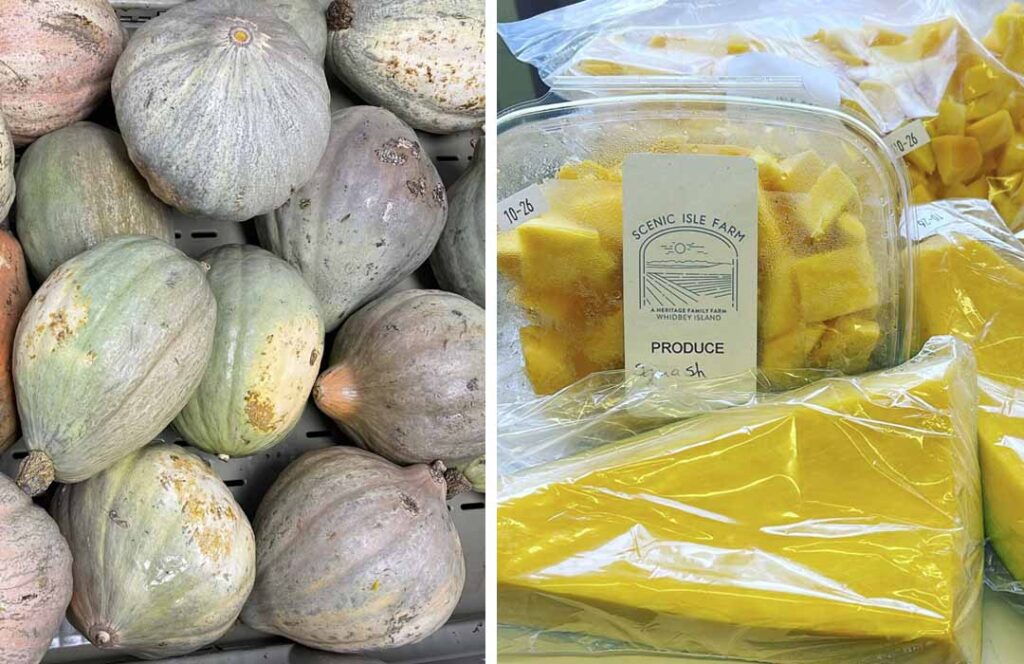
The sugar Hubbard isn’t just another squash; it’s a piece of Whidbey’s agricultural history. Since the 1950s, it has been the farm’s signature crop — a unique heirloom variety that Alix’s grandfather developed in partnership with Washington State University. A hybrid of sweet meat and Hubbard squash, it was bred specifically for the island’s climate and ecosystem.
“Some of them can get up to 50 pounds, and we process them, cube them, and package them. So many in our community have savored the squash over the years,” Alix shares. “This hybrid really utilizes our climate and ecosystem.”
With its dense, flavorful flesh, sugar Hubbard squash has become a seasonal staple in kitchens and restaurants across the region. Almost every restaurant in Coupeville features it on their menus during harvest, grocery stores carry it in abundance, and Scenic Isle Farm ensures that thousands of pounds make their way to local food banks and even the Puget Sound school system, where children are introduced to its rich, sweet taste. “It’s been incredible to see how well loved the squash has been between both children and adults,” Alix shares.
Scenic Isle Farm is part of a rare phenomenon: a concentrated farming community within a protected historical reserve. Here, old and new come together in a way that gives the land its own kind of energy. “I’m a fifth generation farmer, so our family has been farming on the prairie since 1892,” Alix says. “We have the most beautiful community, and we’re so proud to be part of this legacy and community that is carrying on from generations before and onto the future.”
That community is not just multigenerational farmers like Scenic Isle Farm; it’s also newer farms, experimenting with fresh ideas and crops. “There’s this combination of old multi-generational farming and then newer farmers paving the way with newer and unique practices,” Alix explains. “It’s hard for me to describe how supportive the community has been — making sure they support local while also giving their families a taste of what it’s like to be on the prairie and continue these legacies.”

Part of what makes Scenic Isle Farm’s crops — especially the sugar Hubbard squash — so distinctive, is the land itself. The prairie’s soil, formed by glaciers thousands of years ago, is considered world-class for farming. Within the reserve, there’s a unique collaboration between farmers and preservation efforts, making it truly one of a kind in the nation.
To visit Scenic Isle Farm is to experience more than just rows of sunflowers, pumpkins, or squash. It’s to step into a living legacy, shaped by history, community, and the enduring relationship between land and farmer. From restaurants to schools, from locals to visitors, the sugar Hubbard squash has become a shared flavor of Whidbey and Camano Islands — a reminder of the island’s rich agricultural heritage and the people who keep it thriving.